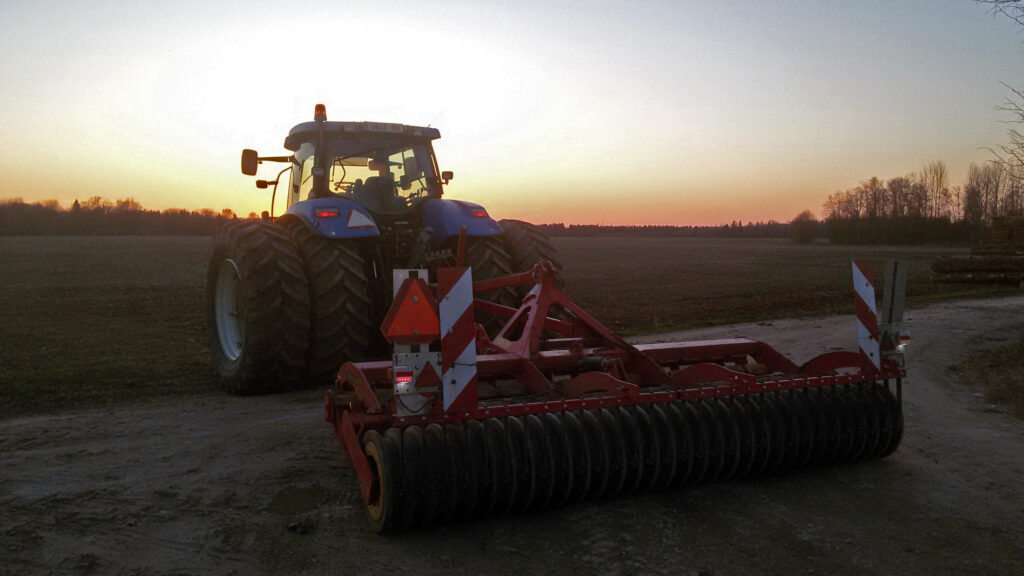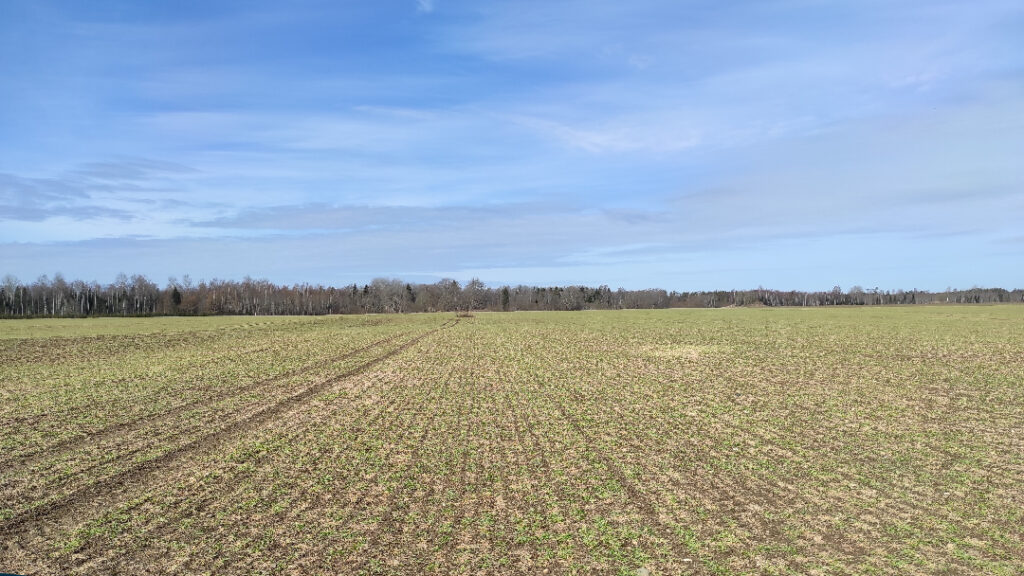
I have been growing rapeseed since the beginning of my farming career (2011), and it was already grown on the farm before me. Like most people, I started with spring rapeseed and later moved to winter rapeseed. Although due to a combination of circumstances I don’t have winter rapeseed this year, I have a feeling that even spring rapeseed can be more profitable than any other crop?
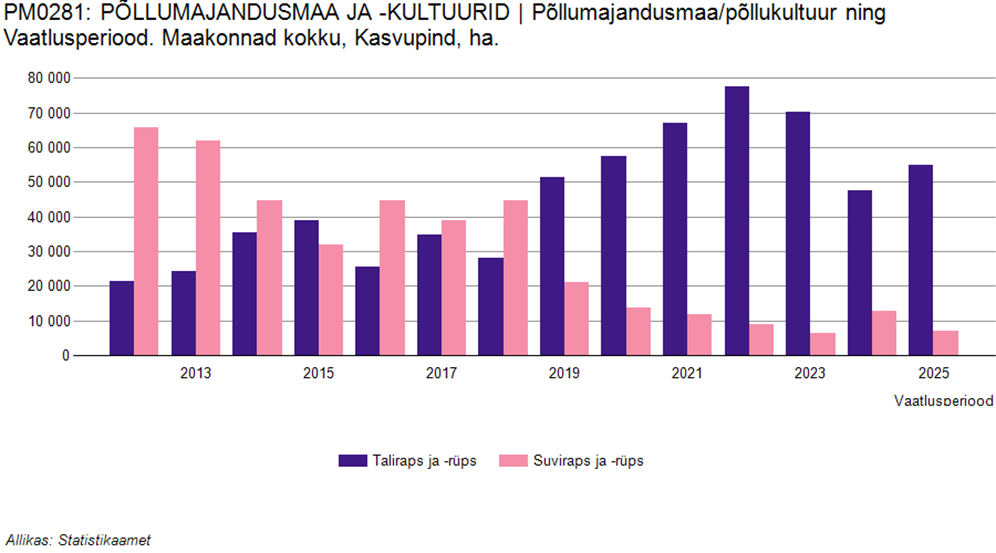
What is the most difficult part of growing rapeseed?
Tillage? Sowing? Fertilization? In my opinion, rapeseed is quite an easy crop in these aspects. It can be sown with conventional seed drills, direct drills, or cultivation seeders – after ploughing, with minimum tillage, or directly into stubble. A universal crop that generally performs reasonably well in all kinds of conditions. Just don’t forget sulfur fertilization!
BUT! Crop protection! Do you remember those good times when we still had Proteus and Biscaya? One spray and hooray, insects were no longer a problem. After these products disappeared from the market (2021 was the last year they could be used) and no equivalent replacement emerged, things in rapeseed production really started to fall apart.
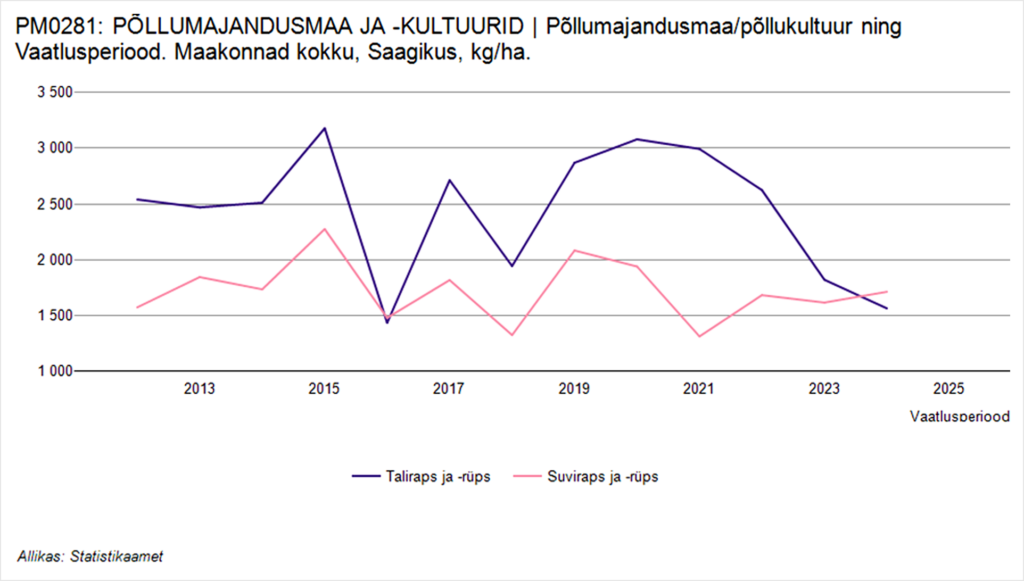
After crop protection options disappeared in 2021, spring rapeseed cultivation almost vanished from the radar because spraying simply couldn’t keep up with the pest pressure. In 2024, winter rapeseed also failed badly for many farmers. Pressure from different insects + May frosts + drought, and some companies swore they were done with rapeseed altogether!
However, the price of rapeseed has been quite good, and the low grain prices mean rapeseed cultivation remains promising. And let’s be honest – it is also a very good crop in rotation.
Winter rapeseed profitability calculation 2026
Let’s look at the numbers! First winter rapeseed. With the arrival of new hybrids, nitrogen use efficiency in winter rapeseed has become very good, and for a 4 t/ha yield target, 200 kg/ha of nitrogen is clearly too much by today’s standards!
Seed costs about 70 €/ha
To produce 1 ton of yield the crop needs:
- Nitrogen (N): 40 kg
- Phosphorus (P): 10 kg
- Potassium (K): 20 kg
- Sulfur (S): 10 kg
Fertilizer prices: NPK 10-26-26 579 €/t, N27+4S 365 €/t.
Crop protection in winter rapeseed
- Boron – 600 g/ha during the whole vegetation period
- 2 growth regulator-fungicides in autumn, 2 fungicides in spring
- Ideally 2 herbicide applications in autumn, repeat in spring if needed
- At least 2 insecticides (cabbage stem weevil and seed pod weevil)
Technology and logistics
- Minimum tillage – 2× subsoiler cultivation (25 cm) + sowing with Horsch Pronto 6DC
- Fuel consumption: 2× cultivation 20 l/ha + sowing 7 l/ha + harvesting 20 l/ha + 7× spraying + 3× fertilization = 20 l/ha (diesel price 0.6 €/l)
- Drying 20 €/t
- Transport 100 km
- Rapeseed base price (40% oil content): 440 €/t
- Fixed costs on average 500 €/ha
All costs are presented per hectare. The table does not include subsidies.
| Yield t/ha | Revenue €/ha | Fertilizer | Crop protection | Seed | Fuel | Gross margin | Drying | Transport | Fixed costs | Result €/ha |
|---|---|---|---|---|---|---|---|---|---|---|
| 1 | 440 | 93 | 250 | 70 | 40 | -13 | 20 | 10 | 500 | -543 |
| 2 | 880 | 186 | 250 | 70 | 40 | 334 | 40 | 20 | 500 | -226 |
| 3 | 1320 | 279 | 250 | 70 | 40 | 681 | 60 | 30 | 500 | +91 |
| 3.5 | 1540 | 326 | 250 | 70 | 40 | 844 | 70 | 35 | 500 | +239 |
| 4 | 1760 | 372 | 250 | 70 | 40 | 1008 | 80 | 40 | 500 | +388 |
| 5 | 2200 | 465 | 250 | 70 | 40 | 1355 | 100 | 50 | 500 | +705 |
| 6 | 2640 | 558 | 250 | 70 | 40 | 1702 | 120 | 60 | 500 | +1022 |
At 3 t/ha yield and even with quite high fixed costs, there is profit before subsidies! My own rapeseed profitability this year confirms this. It is clear that if winter rapeseed survives the winter, the foundation for a good yield is already very strong.
Spring rapeseed profitability calculation 2026
The reader might experience a slightly schizophrenic situation: in one paragraph I claim spring rapeseed can be very profitable, and in the next I say it’s not worth growing because of insect pressure. Well, a few years ago I also swore I would never sow spring rapeseed again… but sometimes you have to butter your own words so they slide down more easily. Looking at wheat profitability calculations, where profit often appears only at around 8 t/ha, the profitability of spring rapeseed at 2.5 t/ha starts to look much more attractive.
There have been reports that spring rapeseed has been grown quite successfully in the past couple of years. According to my own experience, I have had spring rapeseed yields above 2.5 t/ha in 7 out of 9 years. True – during the time when good systemic insecticides were still available.
With our backs against the wall, it seems we have to take the risk.
The technology is similar to winter rapeseed, but spraying costs are lower:
- 2 herbicides – for broadleaf and grass weed control
- 2 fungicides/growth regulators – at the 3–4 leaf stage and at full flowering
- 4 insecticides – flea beetle, cabbage stem weevil, pollen beetle 2×
| Yield t/ha | Revenue €/ha | Fertilizer | Crop protection | Seed | Fuel | Gross margin | Drying | Transport | Fixed costs | Result €/ha |
|---|---|---|---|---|---|---|---|---|---|---|
| 1 | 440 | 93 | 158 | 70 | 35 | 84 | 20 | 10 | 500 | -446 |
| 1.5 | 660 | 140 | 158 | 70 | 35 | 257 | 30 | 15 | 500 | -288 |
| 2 | 880 | 186 | 158 | 70 | 35 | 431 | 40 | 20 | 500 | -129 |
| 2.5 | 1100 | 233 | 158 | 70 | 35 | 604 | 50 | 25 | 500 | +29 |
| 3 | 1320 | 279 | 158 | 70 | 35 | 778 | 60 | 30 | 500 | +188 |
| 3.5 | 1540 | 326 | 158 | 70 | 35 | 951 | 70 | 35 | 500 | +346 |
It’s tight – very tight. A 2.5 t/ha spring rapeseed yield is not unrealistic at all, but there isn’t a huge amount of room for improvement either.
Conclusion
The price of rapeseed is objectively good, and with a normal yield there is real potential to make money. In any case, I have seen more 2.5–3 t/ha rapeseed yields than 8 t/ha wheat yields. In my opinion, the most difficult part is managing fertilizer inputs (which are expensive relative to the crop price) in such a way that the crop has sufficient nutrients but profitability is not lost. It is a very thin line with little room for mistakes.