This post was prepared in collaboration with Paul-Tech
Water creates yield. Water in the soil is like blood in the human body – fertilizers dissolve in water, water carries nutrients to plant roots, and determines whether a plant wilts, survives, or suffocates.
After installing Paul-Tech soil stations, I began to see just how different the water regimes of various fields and soils can be – not just by intuition, but based on real data.
Soil Water Across Different Fields: Real Data
- Murumäe field – soil moisture during the 24/25 season ranged from drought stress to excess water
- Oonurme field – the range was slightly smaller, but the movement was still clearly visible on the graph
- Veski field – soil moisture was one long straight line throughout the season, meaning constant excess water
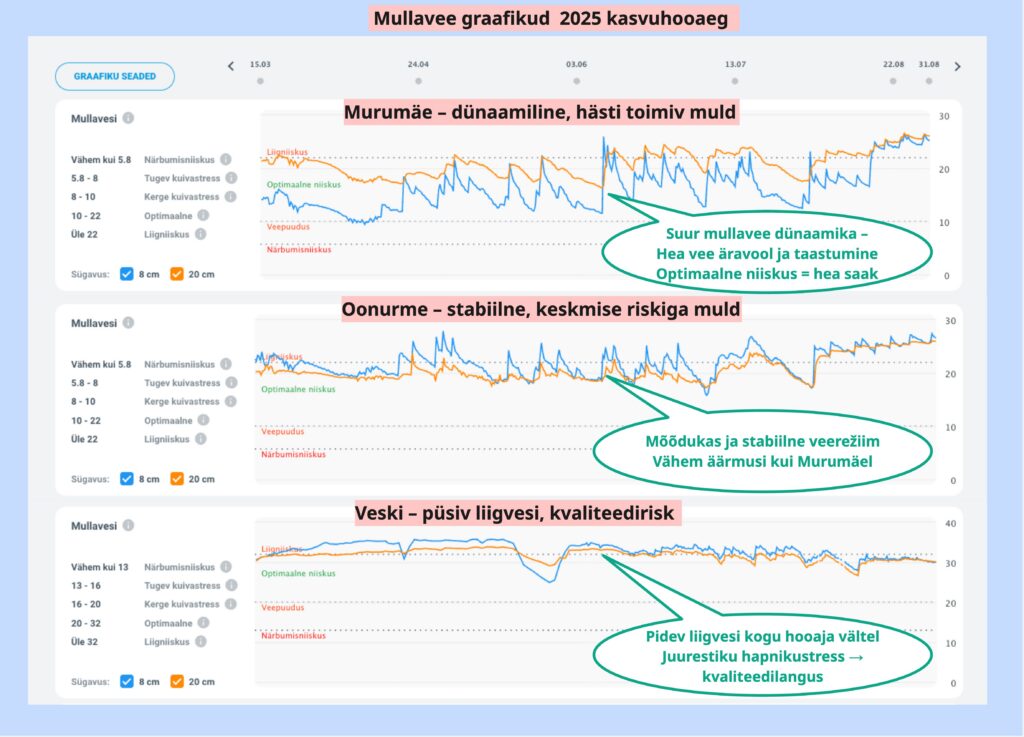
Of course, based on experience I knew these fields were different, but previously it was more a matter of feeling – I lacked the data to actually prove those differences.
Did the Weather Go Overboard With Rain?
Initially, I planned to use soil moisture indicators to decide whether fertilizer application was worthwhile at all. If soil moisture, after a prolonged dry period, has reached drought stress or even the wilting point, then spreading fertilizer before just a few millimeters of rain makes little sense.
Dry soil behaves like a sponge that has dried into stone – the first millimeters of rain are spent “waking up” the soil, not dissolving fertilizer or moving nutrients to the roots.
The 2024/25 season was unusual: only the Murumäe field briefly faced a risk of drought stress in spring; otherwise, moisture was sufficient or even excessive. Fertilizer dissolution worked like in a textbook – I spread it, soil moisture plus a light rainfall followed, and nutrients were present at 8 cm depth within 5–6 days.
Soil Moisture and Trafficability: A Practical Field Decision
There was a lot of frequent rainfall, and soil moisture readings can also be used to estimate soil trafficability, for which Paul-Tech provides daily reports. For example, I planned to fertilize winter wheat, but the previous evening we had a heavy downpour (~30 mm), and my intuition said there was no point in going out to damage the fields.
However, the Murumäe soil station showed the next day that trafficability was sufficient, and driving on the field would not cause excessive damage. I went, applied the fertilizer, and indeed no deep ruts formed either in the tramlines or beside them.
Excess Water and Wheat Quality
Until harvest, it was interesting to watch how the moisture level in the Veski field hardly dropped below excessive – so this must mean an especially epic yield?! But when the yield figures and quality problems began to appear, concern set in.
And the concern was justified: the test weight of wheat from the Veski field was 620 g/L, far below any quality standard – and by a large margin. Yield was 4 t/ha at 150 kg N applied; it would be funny if it weren’t so sad!
Meanwhile, at the Murumäe field, where soil moisture stayed roughly within the optimal range, test weights were 750–760 g/L, suitable for Class II and III milling wheat.
When we had a few days of good harvesting weather, I made a decision based on the Paul-Tech station: harvest Murumäe first and leave Veski for later, because I was about 99% sure that excess moisture had already caused quality issues in the Veski field.
Conclusion
While in previous years we have struggled with drought stress, the 24/25 season proved that yield can be limited even more by excess water – not to mention the quality problems. In hindsight everything seems logical, but that’s hindsight wisdom. I prefer precision science before the consequences 😀
Plenty of fertilizer and lots of rain means a high risk of nutrient leaching?! In the next post, I’ll go into the observations I made about nutrient movement, the decisions that followed – and which myth turns out to be complete nonsense!