Read more about how I calculate my figures here.
The numerical data, including costs and revenues by crop, comes from eAgronom’s budgeting and analysis tool. I understand Excel quite well too, but at the request of the eAgronom team I’m testing the full functionality of their field book and, honestly, if you put in the right data, you get a very broad and up-to-date overview of where the money actually goes!
The 24/25 season was supposed to be epic. Why? Because neither I, nor the crop production sector in general, could afford a third bad year in a row.
Everything is fine as long as grain farmers have a nice fat payday in autumn. You pay off your debts, loans and leases and still have enough money left in the account to live, invest and get by until the next harvest. The big problem arises when all the costs have already been incurred in anticipation of a big yield, but in autumn it turns out there is no crop. You can’t really cut costs anymore either, because the last major spending usually happens a few months before harvest.
That’s exactly what happened to us in the 22/23 and 23/24 seasons. Fortunately, grain prices in those years were, in hindsight, decent, which compensated for the lack of yield to some extent. Despite that, the debts kept piling up and constantly rolling them over into the next year just meant digging a deeper and deeper hole. We needed a super year to get out of it, and 24/25 seemed to be exactly that.
In autumn 2024 I sowed 138 ha of winter wheat (“Ahoi”, “Informer”, “Olivin” + a hybrid trial) and 18 ha of winter rapeseed (“Texas”). That made up just over half of my sown area. Experience from dry years has shown that winter wheat usually pulls the chestnuts out of the fire, and growing three different varieties seemed like a sensible way to spread the risk.
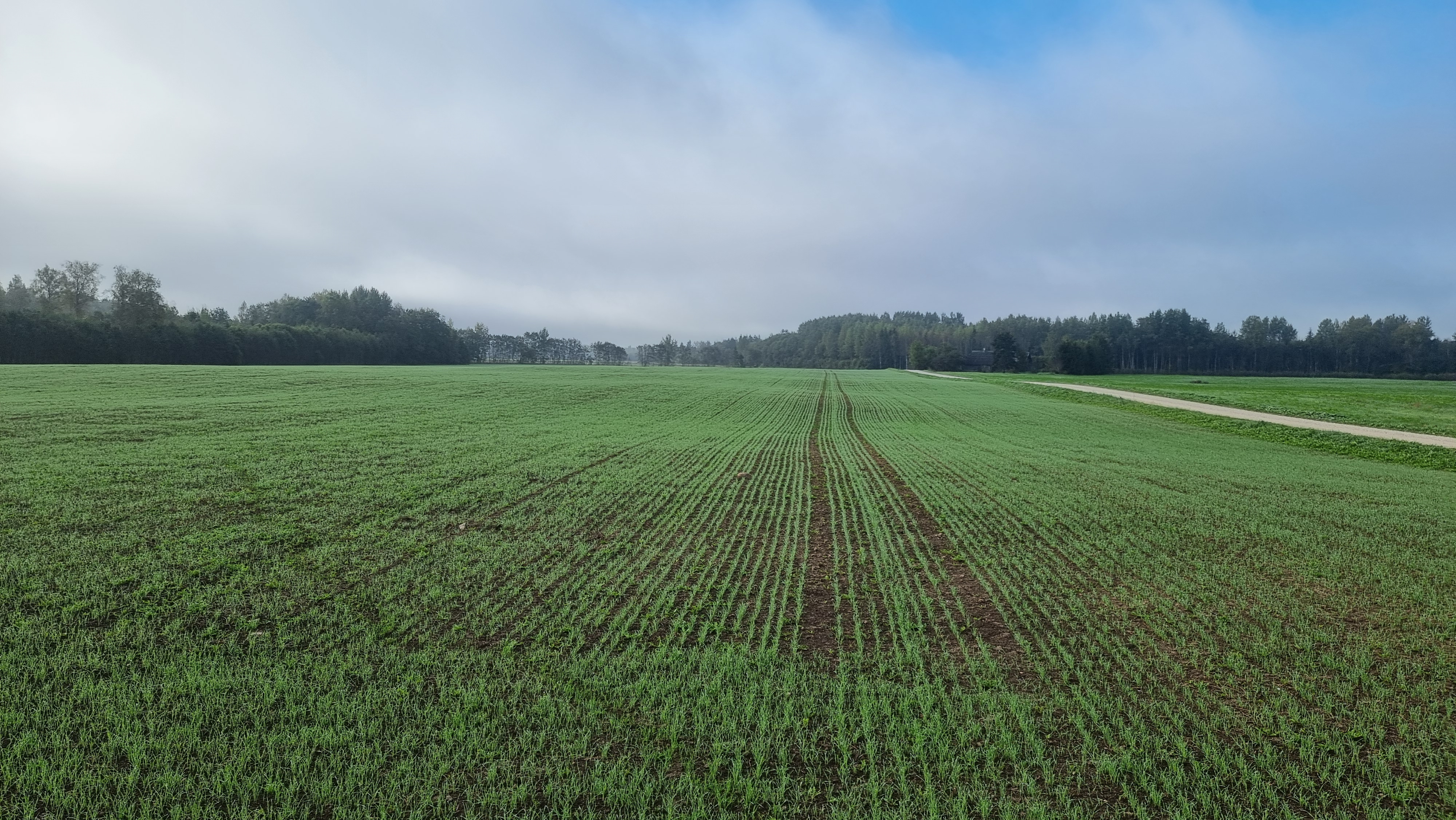
My perception of the 2024/25 autumn and winter – in my view it was one of the best winters for winter crops in my entire career. There was no severe frost and, at the same time, we didn’t have a long-lasting snow cover on unfrozen soil, which would have created a perfect environment for snow mould and crop loss.
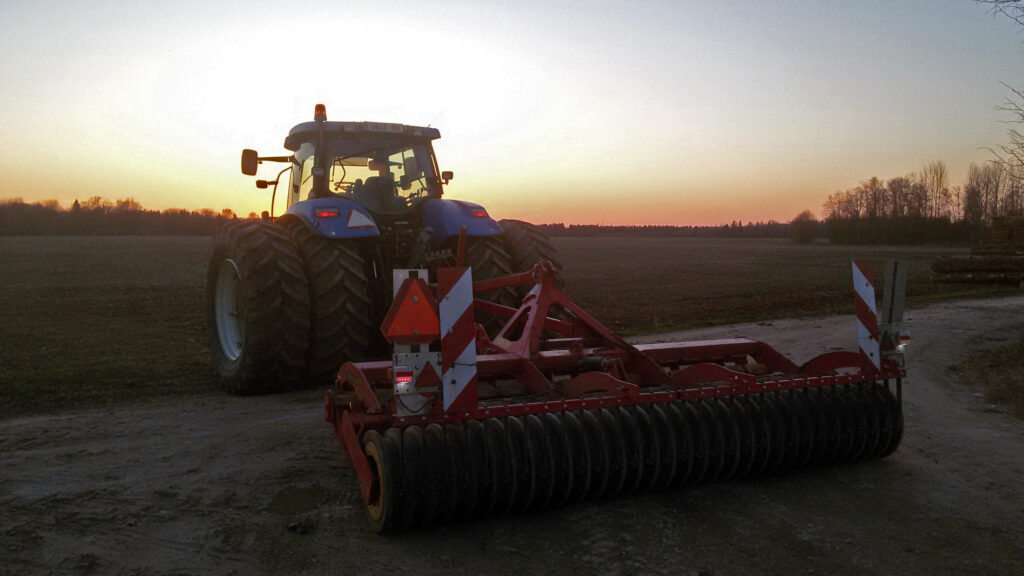
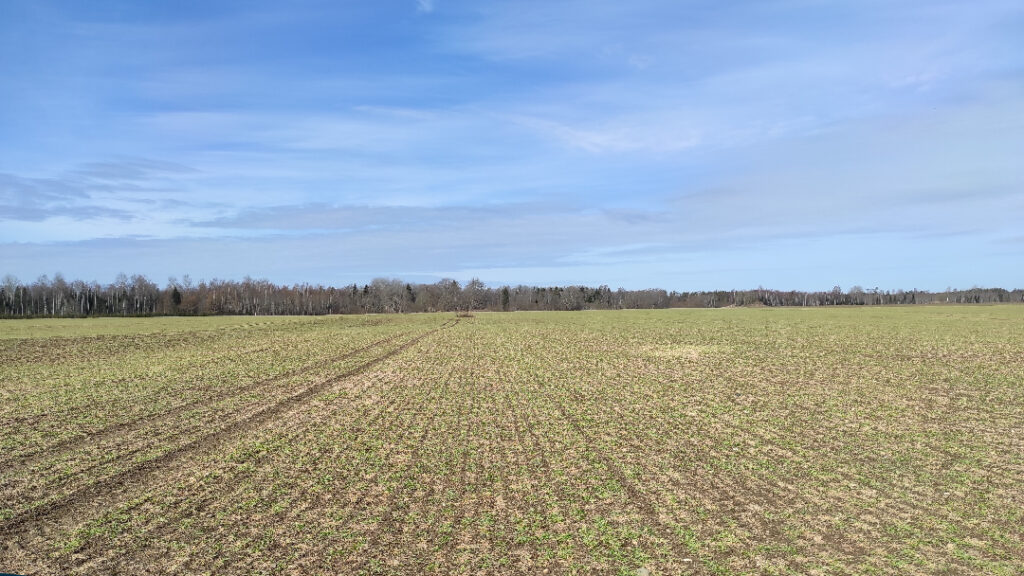
Spring fieldwork in Jõgevamaa started already at the end of March with fertilising. Plant protection on winter crops began at the end of April, as night frosts delayed spraying. Things still got done more or less on time, although in some places at the cost of some pretty impressive mud tracks.
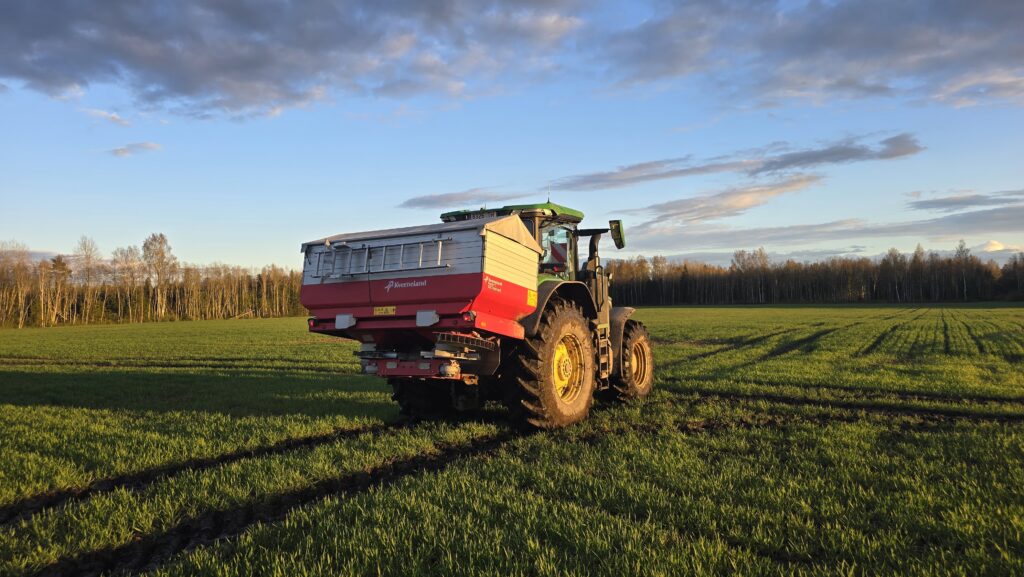
In spring I sowed 52 hectares of field peas (“Symfony” and “Respect”), 50 hectares of oats (“Symphony”) and 25 hectares of field beans. Beans returned to the rotation after an 8-year break. The last time I sowed them was in 2017 and after harvesting 10 tonnes at 50% moisture, breaking the dryer and incorporating the rest of the crop back into the soil, I promised myself “never again”. At the same time, 77 hectares of peas felt too risky, so I decided to include beans in the rotation and chose the earlier variety “Louhi” to reduce the risk of very late maturity.
Spring sowing dragged on because of rain and cold, and we finished fieldwork on 15 May. All in all, I was reasonably satisfied with that. The following growing season was, in my opinion, fairly favourable. Moisture and suitable temperatures did encourage weeds, diseases and pests, but with some extra work we managed to keep things under control. The tracks in the tramlines did get deeper and deeper in places, but I dare say 99% of farmers, researchers and agronomists agreed that the conditions for a good harvest were in place. Some even predicted that Estonia’s yield records would be broken. With that kind of optimism we headed into harvest.
Of course, there was also the risk that it might simply be too wet. This was confirmed by the summer rainfall total, which was 139% of the long-term average in Estonia. I mainly saw this as a risk from the harvest point of view – would we have to combine with very high grain moisture or even risk getting stuck? When the first reports started coming in about winter barley and winter wheat yields being lower than expected and about quality issues, real concern kicked in.
Next, let’s look at the results in more detail – starting from the worst and finishing with the best. One clarification before we dive in: the costs shown are the DIRECT costs of growing the crop (fertiliser, plant protection, seed, machine fuel). All fixed costs – repairs, loans, leases, land rent, labour costs etc. – are left out for the sake of comparability. As a rule of thumb, you can assume around 400–500 €/ha in fixed costs.
- Field pea – 52 ha, 6 fields
- Variety: “Symfony” (farm-saved seed) and “Respect” (certified seed)
- Spring N: 0 kg/ha
- Yield: 1 t/ha
- Variation: not possible to measure
- Cost: 258 €/ha
- Average selling price: 220 €/t
- Gross margin: –35 €/ha
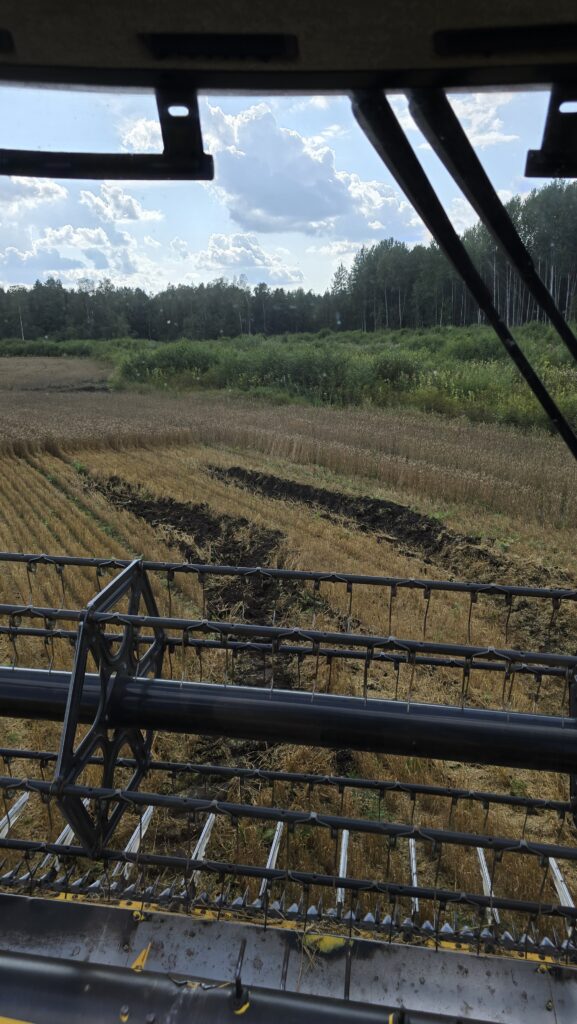
- Comment: I was expecting an average or slightly better pea year, i.e. 3+ t/ha. Instead, it turned into a complete disaster. 25 hectares had to be worked back into the soil and the remaining area produced an average yield of about 2 t/ha. Constant rain caused severe lodging, excess moisture ruined the yield and harvesting basically meant running soil through the combine. I’m done with growing peas!
- Oats – 50 ha, 3 fields
- Variety: “Symphony” (certified seed)
- Spring N: 98 kg/ha
- Yield: 3.8 t/ha
- Variation: 3.3–4.4 t/ha
- Cost: 325 €/ha
- Average selling price: ~155 €/t (milling oats)
- Gross margin: +268 €/ha
- Comment: I expected at least 5+ t/ha and the potential was there, but excess moisture ruined it. Harvesting was difficult because of green straw and one field was badly lodged by hail. In 2024 I got 215 €/t for milling oats, this year 155 €/t – a 60 € difference. At this price and yield level it’s very hard to see oats as a profitable crop.
- Winter wheat – 138 ha, 11 fields (11 ha hybrid, 127 ha line varieties)
- Varieties: “Informer”, “Olivin”, “Ahoi” + 5 hybrids
- Spring N: 99–151 kg/ha (up to 180 kg/ha with variable rate)
- Yield: 4.8 t/ha
- Variation: 3.9–6 t/ha
- Cost: 570 €/ha
- Average selling price: 178 €/t
- Gross margin: +283 €/ha
- Comment: In normal years, the average winter wheat yield has been around 7 t/ha with less nitrogen. So I didn’t even consider anything under 7 t/ha. Winter wheat needs to generate around ~1000 €/ha in revenue to really make sense, but the combination of low yields and low prices wiped out that hope. The very wet year also caused major quality problems – I did get some bread wheat in different quality classes, but the majority ended up as feed wheat or low test weight “rubbish”.
- Field bean – 25 ha
- Variety: “Louhi”
- Spring N: 11 kg/ha
- Yield: 3 t/ha
- Average selling price: 220 €/t
- Cost: 345 €/ha
- Gross margin: +315 €/ha
- Comment: I expected around 3 t/ha and that’s what I got. Considering my previous bad experience with beans, I still took the risk and luckily it paid off. There were a lot of waterlogged patches in the field, so for an early variety I’m happy with the result. Yes, there were much better yields in Estonia with later varieties, but better a bird in the hand than two in the bush.
- Winter rapeseed – 18 ha, 2 fields
- Variety: “Texas”
- Spring N: 90 kg/ha
- Yield: 3.4 t/ha
- Variation: 3.2–3.5 t/ha
- Cost: 652 €/ha
- Average selling price: 450 €/t
- Gross margin: +856 €/ha
- Comment: I was hoping for at least 3 t/ha and that’s what I got – finally! Winter rapeseed did well despite the fact that spring nitrogen was only 90 kg/ha, because the fields are on a karst area with fertiliser restrictions. I followed the advice from my earlier blog post, didn’t overdo it and invested moderately. The reward was a good feeling both while combining and later when looking at the numbers.
In conclusion, if this had been the first bad year among good ones, you could say “we’ll live”. But producing losses for the third year in a row is just too much. Low grain prices combined with low yields meant that the final result was even worse than in previous years.
What hurts the most is that beautiful fields never turned into beautiful yields. The gap between what we hoped for and what we actually got was so huge that it really took a toll on mental health… cubed.
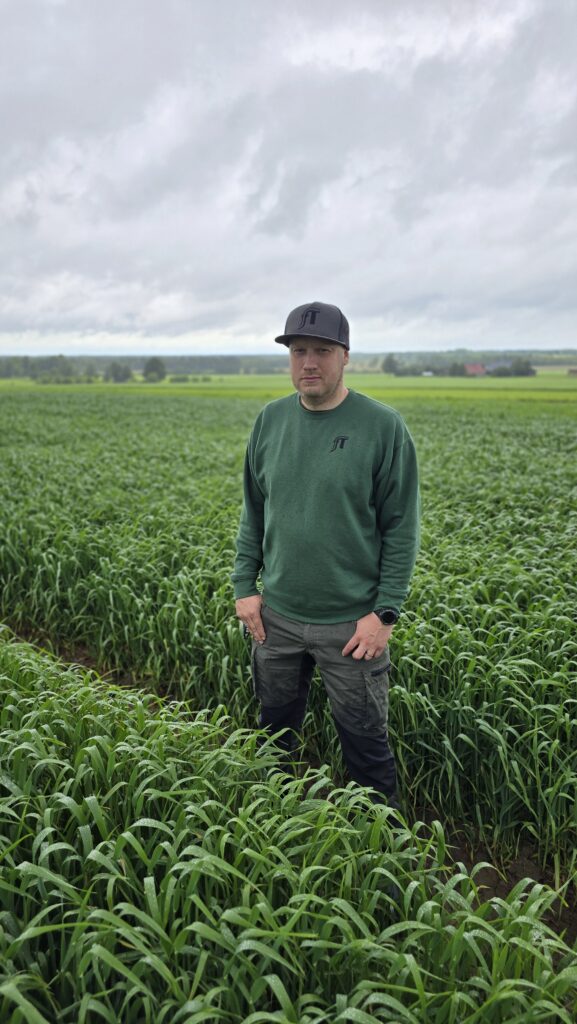
What did lift my spirits? Winter rapeseed and beans. The first gave a good yield and a solid financial result, the second was just so easy to harvest that I actually found some joy in combining again 😀
I’m not going to sugarcoat it – it was a hellishly tough season and despite a lot of effort and a positive attitude, the result is what it is. Luckily there’s now some time to think and get ready for the next season, but it feels like I’ll be going into it with some different ideas. Some things I’ll keep doing the same – that’s the “magic” of farming: do the same thing every year and you still get a different result 😀 Some things I’ll do completely differently and maybe there will be something entirely new as well?!
What happens next, why I didn’t sow winter rapeseed this time and whether I’m borrowing too much from the soil – more on that in future blog posts.
PS! I know despair sometimes feels like a national sport in Estonia, but let’s agree we’re not signing up for that event just yet!