Since 2024, I have been insuring my fields against drought, storms, hail, and winter damage in cooperation with Eurorisk. In the case of spring crops, I have already received compensation twice — for the 2024 drought and the 2025 hail/storm damage.
This spring, I got my first real experience of what winter crop insurance means in practice.
With winter crops, the biggest risk is the long period between sowing and harvest. In autumn, the field may enter winter in perfect condition, but when the snow melts in spring, you may be facing a complete disaster. The weather in recent years has become so unpredictable that managing such risks feels increasingly necessary.
For the 2025/26 season, I insured 120 hectares of winter wheat and 54 hectares of winter triticale. When insuring the fields, the policyholder determines the expected yield and crop price themselves. This affects both the insurance premium and the compensation received.
What does it cost?
Based on my figures, the insurance value for 174 hectares of winter crops came to approximately €174,000. Simply put, I estimated that one hectare of winter crops could generate at least €1,000/ha in normal conditions.
The insurance premium came to just over €8,200, or around €47/ha. On one hand, considering the risks involved, that is quite understandable. But honestly, it is still painful to pay that amount of money these days.
Fortunately, in Estonia we have a support measure from PRIA called agricultural insurance support. Through this measure, it is possible to receive support covering up to 70% of the insurance premium. In my case, the support amounted to €5,740, meaning I had to find €2,460 from my own pocket, or roughly €14/ha. Considering that growing winter wheat may cost €400–500/ha in inputs and labour, spending around 3% of that on insurance already seems like a very reasonable decision.
I got to “experience” how the insurance works
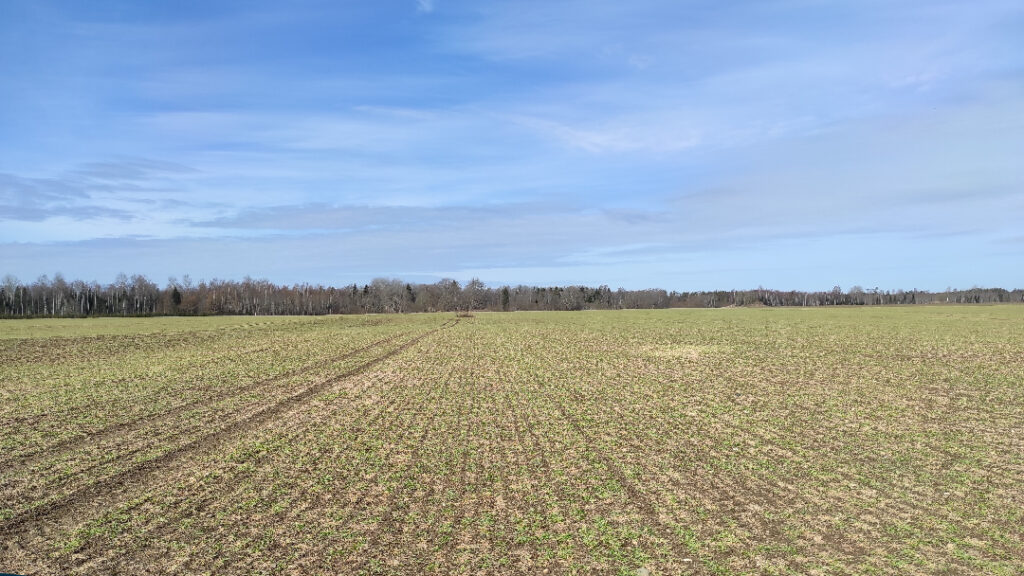
A 22-hectare winter wheat field entered winter in good condition. But when the snow melted, the picture was very different — rows partially gone and large empty patches across the field. I still hoped things might improve. I waited for a while, but it actually seemed to get even worse :D
I called Eurorisk. The expert came out, launched the drone, took a short walk through the field, and the conclusion was clear — total destruction. 100%!

After such a decision, the farmer is free to either leave the field as it is or sow something else there. At that moment, since weather models were once again predicting a drought-prone growing season, I decided to sow hemp on that field.
How much compensation did I receive?
The compensation amounted to approximately €5,500, or around €250/ha.
By that point, I had already spent around €150/ha on fertilizers, crop protection products, and fieldwork. In other words, the insurance essentially covered the expenses already made and still left something for reseeding.
Even after accounting for my own insurance costs and deductible, I was left with around €3,000 in “real” compensation, or nearly €150/ha. My inputs were covered!
Insurance cost for me: ~€14/ha
Compensation for the destroyed field: ~€250/ha
Result: Input costs were covered
Conclusion
For me, it is actually quite simple — the winter wheat was destroyed anyway, and I would have had to pay for those losses and reseeding out of my own pocket. But with insurance, at least my production costs are covered after the crop loss. And considering that the fertilizer already spread remains in the soil for the next crop, the insurance also effectively covered at least the base fertilization for the following crop.

If, for example, 50 hectares of wheat had been destroyed, the compensation would have amounted to €12,500. After subtracting the deductible (around €2,500) and the already incurred costs (around €7,500), there would still be around €2,500 left for reseeding — meaning that even after the deductible, the sowing costs would still be covered.
Over the past two years, I have needed agricultural insurance three times. I really hope it has just been bad luck — but deep down, it feels like the level of risk in agriculture has genuinely changed.
And that is exactly why I now see insurance more as a risk management tool rather than just an additional expense.